
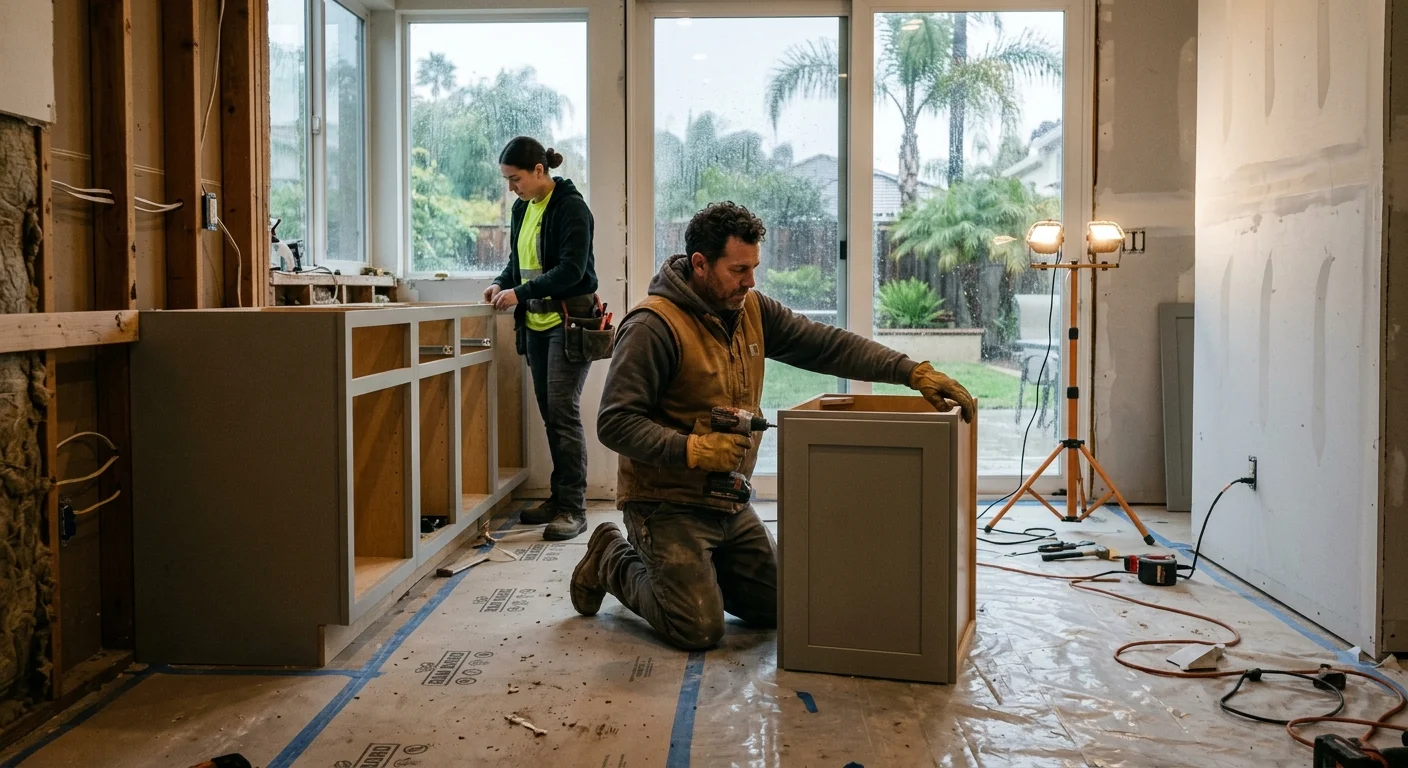
Rain on a Vista ranch roof in January is not a stop-work order for the inside of the house. A winter interior remodel in North County keeps us in rooms you can close, away from a roof opening in a storm. Kitchens and baths still move. Additions wait until those openings can be dried in.
Winter interior remodel work starts with rooms you can close
A room with a door is a job we can contain. The rest of the house stays a house.
In a 1960s Vista ranch, that often means the hall bath first. One door, one window, a fan that already vents out. The kitchen follows if you can cook from a temporary setup in the dining room or the garage. Oceanside tract homes from the 1970s run on the same logic: a galley kitchen on the street side, a hall bath, and a master that still works.
Carlsbad and Encinitas two-stories give you a cleaner split. Close the upstairs bath and live downstairs. Close the kitchen and eat from the family room. San Marcos and Escondido ranches with a converted family room give you a spare zone that already has a door.
What we don’t open in a wet week is the weather envelope. No new skylight hole. No bump-out framed into a rain event. No sliding-door rough-in on a windward Carlsbad wall until the opening can be dried the same day. Interior partitions, cabinets, tile, paint, and electrical in existing walls don’t need that hole.
Zip walls at the door. Floor protection down the hall. A pad under the saw. The closed room is the point of an indoor renovation in winter. The mess has a boundary, and the family has a hallway that still looks like a hallway.
If the plan is bigger than one room, treat it as whole-home remodeling staged by zone, not as one open floor. North County home remodel timing in the wet months is about which door you can shut tonight.
Why kitchens and baths fit the rainy months
Kitchens and baths sit inside the existing box. That’s why they fit a remodel during rainy season.
A kitchen remodeling job in San Marcos or Escondido is cabinets, counters, plumbing in the same walls, and electrical in the same ceiling. We may still open a partition. We don’t have to open the roof. The same pattern holds for bathroom remodeling in a Fallbrook ranch or an Encinitas coastal two-story.
A 1960s Vista ranch still has plaster, galvanized supply lines, and a single hall bath. A 2000s La Costa or San Elijo Hills tract home has wider halls and a master bath you can close while the kids’ bath works. Same winter. Different rooms.
Coastal North County fights moisture all year. Encinitas and Leucadia showers tell on themselves in winter. Grout darkens. A window over the tub sweats. That’s when you see whether the pan was built as a pan. Tile, waterproofing, and a new shower are indoor work. Rain on the glass isn’t in the way.
Inland North County is a different house. Vista, San Marcos, and Escondido ranches from the 1960s and 1970s still hide galvanized lines and bath fans that dump into the attic. Winter is a fair time to replace those from inside. You’re not fighting a hillside excavation while the plumber is in the wall.
Permits still belong with the city that has the address. Vista, Oceanside, Carlsbad, Encinitas, San Marcos, and Escondido each run their own counter. Unincorporated pockets such as Bonsall and Fallbrook go through County of San Diego Planning & Development Services. We talk in permit categories, not fee amounts. A kitchen or bath that moves walls, plumbing, or electrical is not a paint weekend.
Gas lines, panel work, and anything load-bearing stay with licensed trades. That’s not seasonal advice. That’s how the house stays standing.
How dust control matters more when everyone is home
Dust is worse when the house is shut.
North County winters close the windows. The HVAC runs. Fine gypsum and sawdust ride the return. Kids do homework at the dining table. Someone is always home after dark.
That’s a different problem than a summer remodel with the slider open to a Carlsbad patio. Containment has to be tighter.
We hang zip walls at the room, not at the driveway. Negative air, if the layout allows, pulls dust into a filter instead of the hall. Floors get covered past the work zone, because dust walks on socks. Vents in the closed room get taped. The rest of the system keeps heating the family rooms.
Daily cleanup is not a courtesy. It’s how you sleep in the house. Brooms, a vacuum with a real filter, a magnet for screws in the hall. Shoes off at the zip wall.
If you’re living in the house during a remodel, winter raises the bar. You can’t send everyone to the backyard for three hours. Rain pins the family inside with the work. Plan the noisy cuts for the middle of the day. Plan the dusty demo for a room that already has a door. Plan a bathroom that still works every night.
Don’t run a whole-house fan to air the place during a storm. You’ll pull wet air into a warm interior and you’ll spread dust through the returns. Closed rooms, filtered air, and a real door beat a late cleanup.
What to finish before spring addition or ADU work
Finish the inside you already have before you grow the house.
A spring home addition or later ADU construction wants a dry roof opening, a foundation that can be formed, and a family that isn’t also living in a gutted kitchen. Winter is the season to settle the occupied interior: kitchen, baths, floors, paint, lighting.
ADUz handles ADU design and permits at aduz.design. We build. Those are sister companies, not one company. If an ADU is on the calendar for later, use the wet months to lock the main house. The family needs a finished kitchen when the side yard turns into a job site.
A kitchen bump-out, a second story, or a detached unit all punch the exterior. That work belongs in a stretch when openings can be dried in. We don’t promise dry weather. We do limit how long a roof or a wall sits open.
| Work | Winter fit | Why it belongs then |
|---|---|---|
| Kitchen or bath inside existing walls | Strong | Doors close and the roof stays intact |
| Interior paint, floors, and lighting | Strong | Closed rooms, windows shut |
| Addition or ADU shell | Hold | Roof and wall openings fight rain |
| New windows on a windward wall | Hold | Openings need a same-day dry-in |
Escondido and San Marcos lots with slope add mud to the story. A winter trench next to a finished living room is how you track clay across new floors. Form and frame the addition when the ground cooperates. Live in a working interior until then.
How to sequence interior trades around occupancy
Occupancy sets the order more than the calendar does.
Demo one closed zone. Rough plumbing and electrical in that zone. Inspection. Close the walls. Set tile or cabinets. Then open the next door. That’s the short version of how the work goes in. Winter makes the closed-zone rule non-negotiable.
Keep one working bathroom every night. Keep a place to cook, even if it’s a temporary counter in the dining room. Don’t demo the kitchen and the only hall bath in the same week in a one-bath Oceanside bungalow.
Trade stack inside a closed kitchen looks like this.
- Protective floors and zip walls go in before the first saw cut.
- Plumbing and electrical rough-in share the open walls, then those walls close.
- Inspections happen before tile, cabinets, and paint hide the work.
- Finish trades follow: drywall, paint, cabinets, counters, fixtures, then floors if the path is still open.
After inspections, the room returns to the family faster if finishes are staged. Cabinets before counters. Counters before the sink goes live. A live sink is how the house works again.
Before anyone opens a wall, verify the contractor on the CSLB license lookup. Ours is CSLB #1042918. If a downpayment is charged on a home improvement contract, it can’t exceed $1,000 or 10 percent of the contract amount, whichever is less.
When to call us
Interior structural changes, gas, and panel work belong to a licensed contractor, not a weekend tool rental. If you’re planning kitchen, bath, or whole-home work through the wet months in Vista or anywhere in North County, we’ll walk the house and map the closed zones with you. Call us at (760) 605-5002 for a free in-home estimate.