
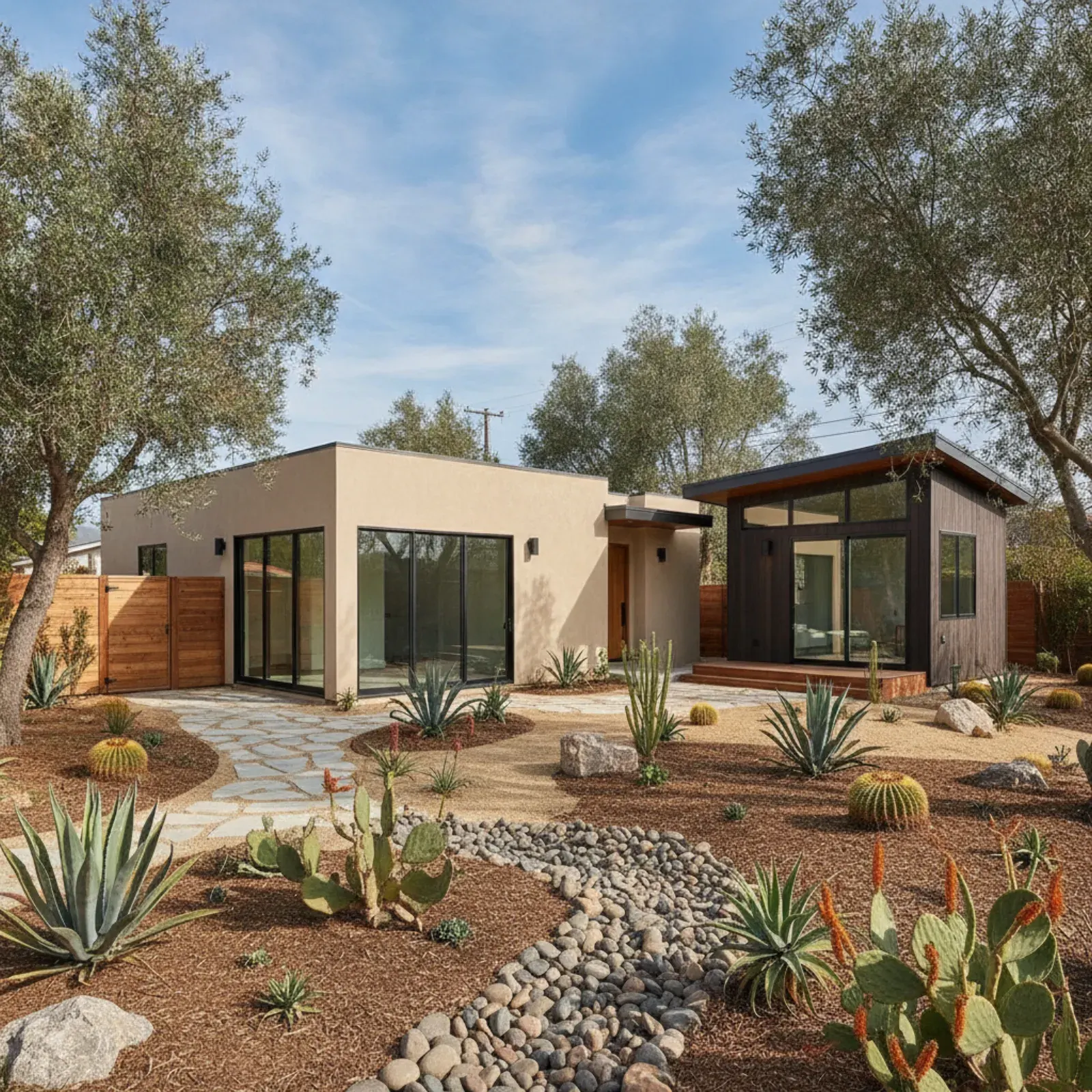
You need more space. That part is clear. What’s less clear is whether you should build an ADU or add on to your existing home. Both give you square footage. Both require permits. Both cost real money. But they serve very different purposes, and choosing the wrong one can leave you with a project that doesn’t fit your actual life.
The adu vs home addition question comes up almost every week in my conversations with San Diego County homeowners. Here’s how I walk people through it.
What each one actually is
A home addition expands your current living footprint. You’re connecting new square footage directly to your existing structure: a new bedroom at the end of a hallway, a bumped-out kitchen, a second-story master suite. The result is one larger home, one address, one utility connection.
An Accessory Dwelling Unit (ADU) is a separate, self-contained living space on your property. It has its own entrance, kitchen, and bathroom. It can be detached (a backyard cottage), attached (sharing a wall), or a garage conversion. Legally it’s a second dwelling, and in California it comes with the right to rent it independently.
What drives the budget in San Diego County
Don’t start with a square-foot guess. Start with how the space will be used, then look at the ground under it.
Home addition. The bid follows how tightly the new rooms tie into the house you already have. A bedroom and bath at the end of a hall is one job. A kitchen expansion that moves structure is another. A full second story is a different class of work because the load path changes. Slab-on-grade houses, common inland and in many North County tracts, mean new footings and careful ties into the existing slab. Raised-floor houses, more common in older coastal neighborhoods, mean a different crawl-space and framing sequence. Coastal lots also fight moisture and setbacks in ways inland lots often don’t.
ADU. A new detached unit is its own building: foundation, shell, roof, and a utility path across the yard. Garage conversions are often the lighter construction path because the shell already exists, but the garage still has to become a legal living space. Junior ADUs are smaller units carved from the main house. Finish level, access from the street, and how far water, sewer, and power have to run will move the number more than a generic size label.
Both paths vary with site conditions and how straightforward permitting is for that specific lot.
| Home addition | ADU | |
|---|---|---|
| What it is | More of the same house | A second dwelling on the lot |
| Kitchen and entrance | Shares the house | Own kitchen, bath, and entrance |
| Who lives there | Part of the household | Independent living, family or tenant |
| Can it be rented on its own | No, it stays one home | Yes, California treats it as a separate unit |
| Design and permits | Tied to the main house | ADUz handles design and permits; Rock builds |
When a home addition makes more sense
Choose an addition when you need the new space to feel like part of your home, not a separate unit. The clearest cases:
- You want a bigger primary bedroom or en suite bathroom
- Your kitchen is too small for how your family actually cooks and gathers
- You need a connected in-law space where an aging parent can live near you but still have some privacy
- Your family is growing and you want the kids to stay under one roof without anyone feeling like they’re living in a separate building
Additions also make sense when your lot doesn’t have room for a detached structure, or when the new space needs to tie directly into your existing HVAC, plumbing, or electrical systems without creating a fully independent unit.
If the person moving in needs to feel like part of your household, build an addition. If you want a rentable unit or a space with true independence, build an ADU.
When an ADU makes more sense
An ADU earns its place when the goal is either income or genuine independence. Rental income is the obvious one. A well-built ADU in North County San Diego can help offset a mortgage, fund the build over time, or create a retirement asset. What it rents for depends on size, finish, parking, and the street it’s on. Use is the decision, not a guessed monthly number.
Multigenerational living is the other big driver. An ADU gives adult children, parents, or in-laws a complete home with privacy and autonomy, while keeping them close. No shared kitchen debates. No single thermostat standoff. Just proximity without friction.
California has made ADUs significantly easier to permit over the last few years, and San Diego County has followed. Setbacks, parking rules, and the local process still depend on the lot. The regulatory environment has genuinely shifted in favor of building them, but the path is still specific to your address.
How The Rock Remodels builds ADUs
Our company works closely with ADUz, our sister company that specializes in ADU design and permitting in San Diego County. ADUz handles the architecture, engineering, and permit coordination. We handle the build.
That structure exists for a reason. Permitting an ADU in California involves state ADU law, local zoning overlays, utility connections, and sometimes HOA restrictions. ADUz does this full time. They know what the city will and won’t approve before we ever break ground. You get a design-build team that has built this exact workflow, not a general contractor who figures out ADU permits one project at a time.
The questions that actually clarify the decision
Before you decide anything, answer these:
- Do you need this space to generate income, now or eventually?
- Will the person using this space need their own kitchen and entrance?
- Is the new space meant to feel connected to your home or independent from it?
- Do you have a rear yard or garage that could support a separate structure?
If the answers point toward independence and income potential, you’re looking at an ADU. If the answers point toward connection and integration, you’re looking at an addition. Sometimes the answers are split, and we’ll walk through the trade-offs with you in person.
Let’s figure it out together
Both projects are significant investments. The right one depends on your property, your family, and your goals. I’m on every job site, I speak Spanish, and I give free in-home estimates.
Call or text David at (760) 605-5002 to schedule a walkthrough. We’ll look at your space, talk through what you’re trying to solve, and give you honest guidance before you commit to anything.